
Resources
The evolution of the pitch deck (with real decks from LinkedIn, YouTube, and Airbnb)
See how startup pitch decks changed from typed business plans to AI drafts, with real decks from LinkedIn, YouTube, Airbnb, and more.

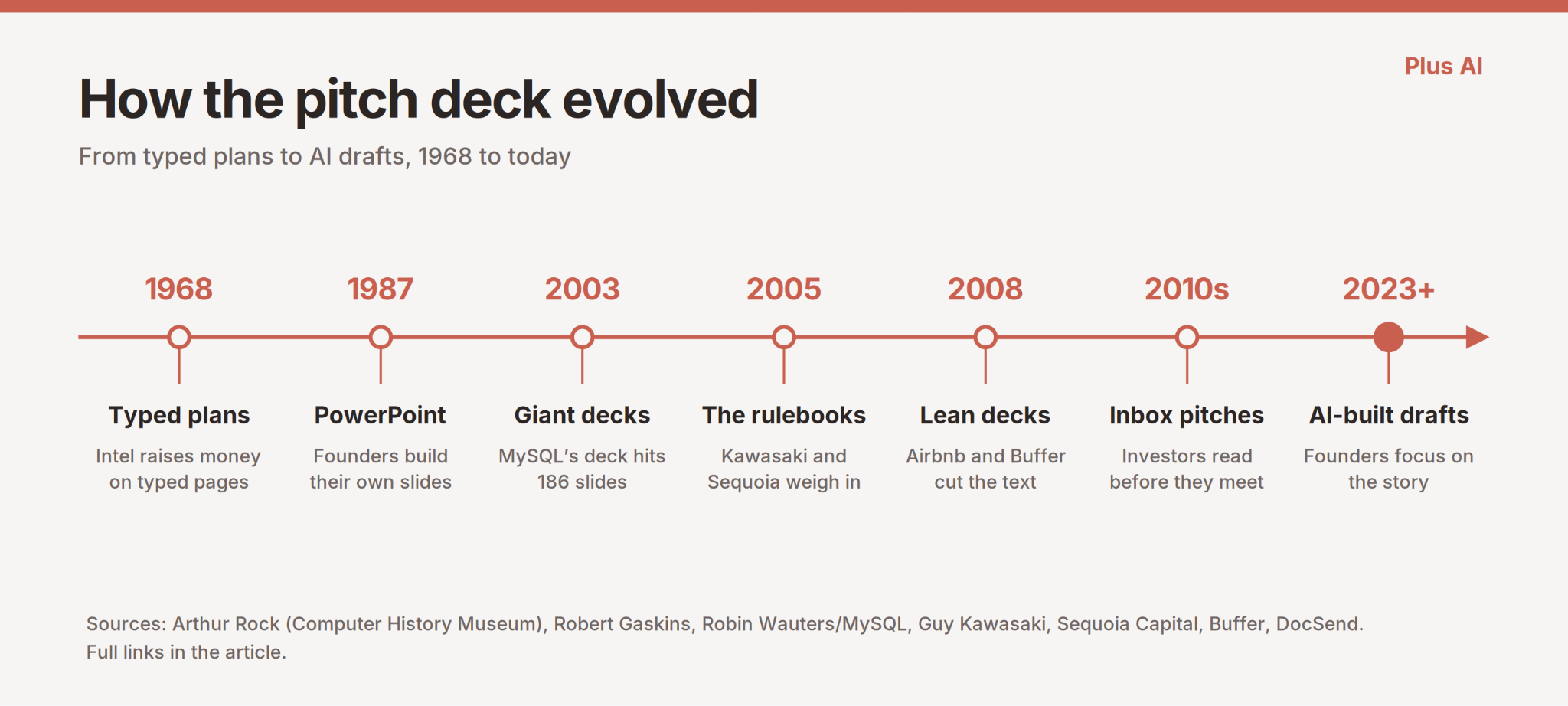
The first startup pitches weren’t decks at all. Founders in the late 1960s and 1970s asked for money with typed business plans, then walked investors through them in person.
Today, most pitches start as a link in an investor’s inbox. In one week of June 2024, DocSend’s pitch deck data showed investors spent an average of 2 minutes and 18 seconds on each deck.
That shift happened in stages. PowerPoint moved pitches onto slides. Investors and founders published templates that fixed the slide order. Seed-stage founders cut the text and let screenshots and charts do the work. Then decks had to make sense without the founder in the room. Now AI tools can build a first draft in minutes.
This article covers the evolution of startup and venture capital pitch decks. We go era by era, from typed business plans to AI-built decks.
Before slides: typed plans and overhead projectors (late 1960s–1980s)
Early venture deals ran on paper (can you imagine?!).
In 1968, Robert Noyce and Gordon Moore left Fairchild Semiconductor to start Intel. Their investor, Arthur Rock, needed something to show other backers, so the founders produced a short typed business plan. Years later, in a Computer History Museum interview, Rock called it “a plan devised to say nothing.”
But the money came in anyway. Intel Capital describes the deal as a $2.5 million convertible note.
Later on, plans weren’t so short. In the same interview, Rock said that once lawyers got involved, business plans grew to two or three inches thick. For context, that’s roughly 500 to 750 pages (or a looooong novel).
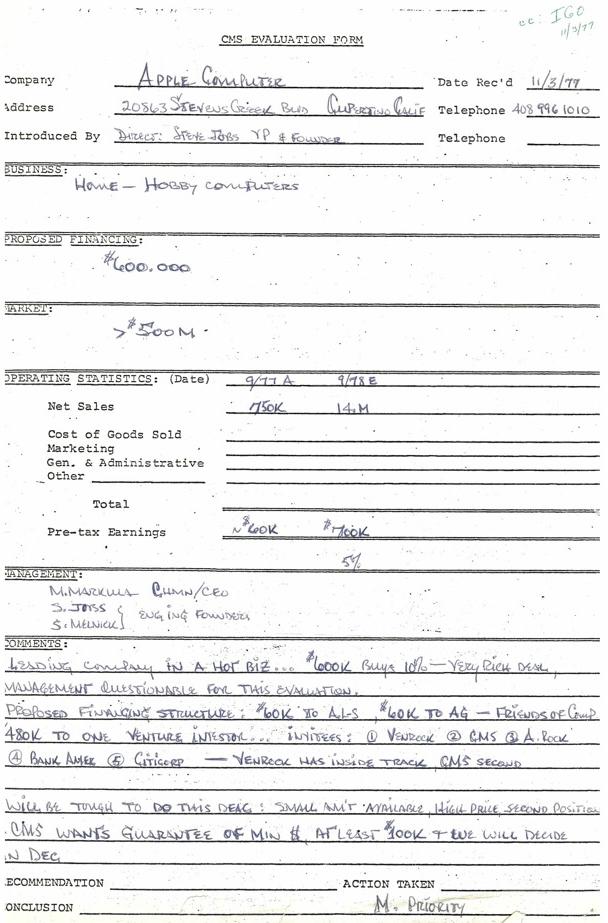
Investors worked on paper too. In November 1977, Sequoia founder Don Valentine typed a short internal memo recommending a $600,000 round in Apple Computer. Sequoia shared the memo publicly for the first time in April 2026, for Apple’s 50th anniversary.
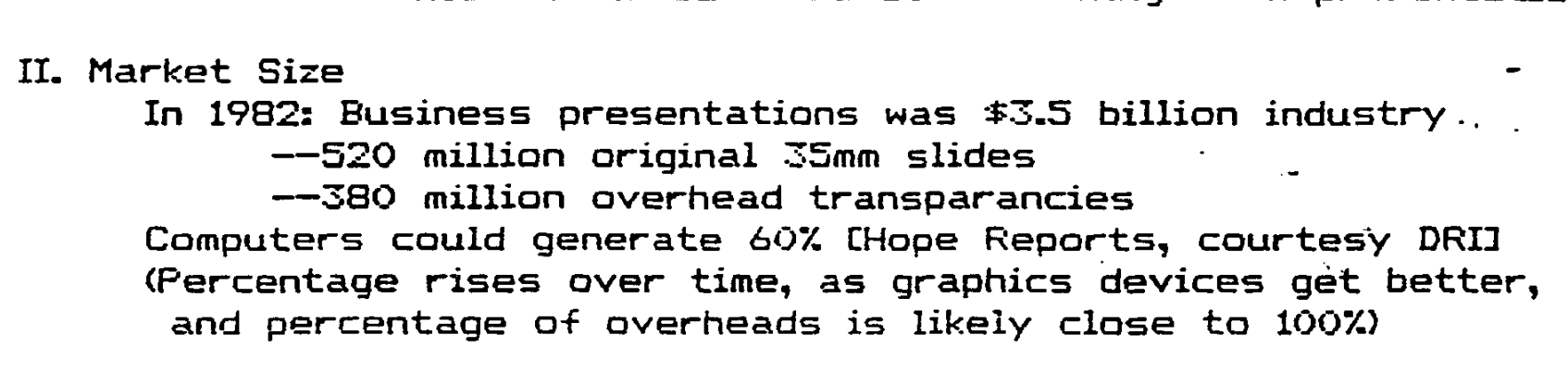
As you can imagine, all these presentations required printing—lots of it. Before presentation software, slides were either clear plastic sheets you laid on a lit projector, called overhead transparencies, or small photo slides shown in a dark room, called 35mm slides. Yes, it sounds like watching a movie.
Robert Gaskins, who later created PowerPoint, counted how many businesses made them in his 1984 product proposal. In 1982 alone, businesses made 520 million photo slides and 380 million plastic sheets ( ). PowerPoint was built to make those slides on a computer instead.
And then…PowerPoint arrived (1987–early 2000s)
PowerPoint 1.0 shipped on April 20, 1987—but only for the Apple Macintosh. Three months later, Microsoft bought the company behind it, Forethought, for $14 million. The New York Times reported it as Microsoft’s first significant software acquisition.
And wouldn’t you know it: PowerPoint was itself a startup that had to win over investors. Gaskins says it was the first product to attract strategic venture capital from the big ol’ Apple.
PowerPoint took slide-making away from typists and photo labs. Founders could now build the deck themselves, and many built decks that read like business plans with page breaks (sounds like…an ebook?).
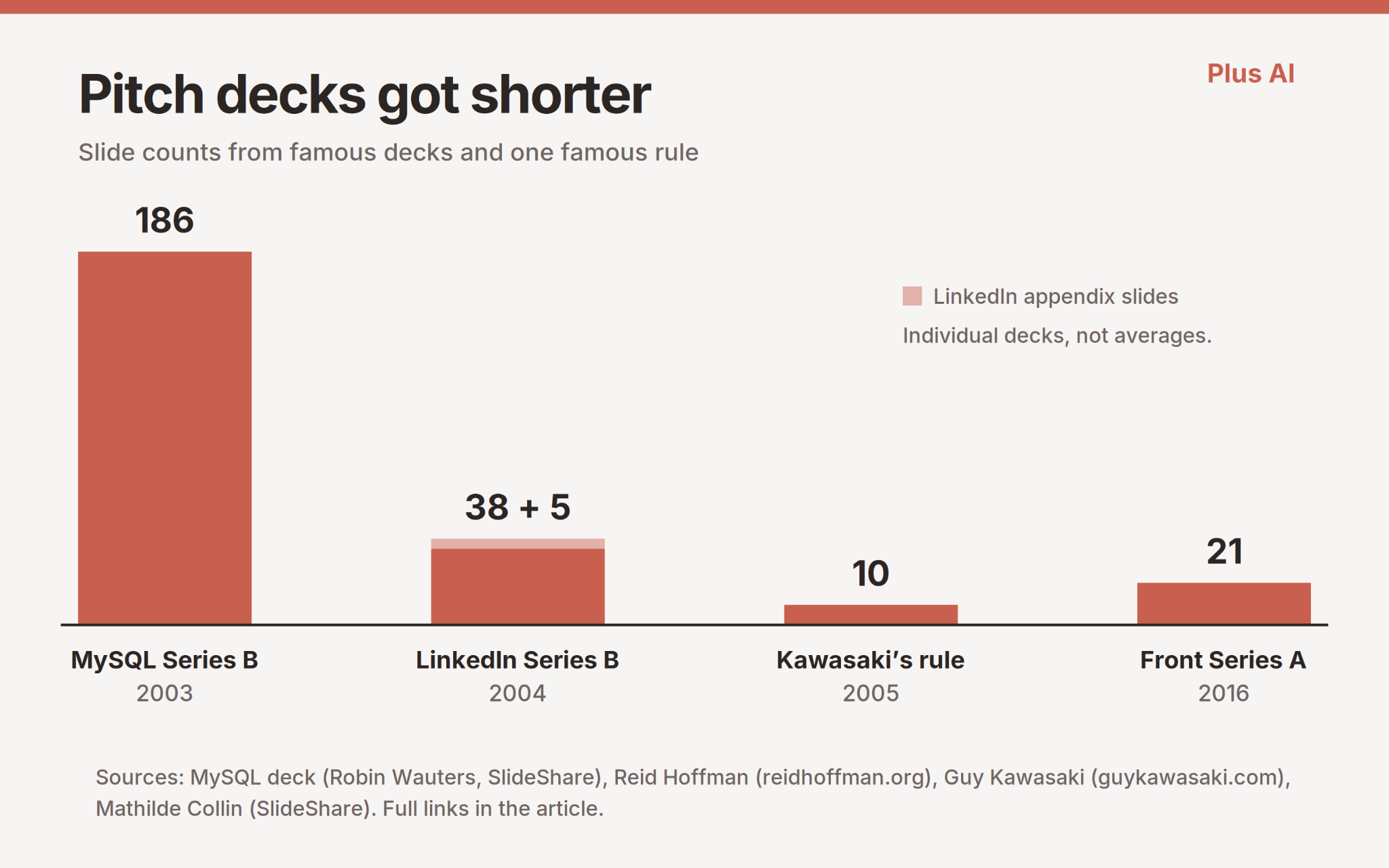
MySQL’s 2003 Series B deck is my favorite early example. It helped the company raise $16 million from Benchmark and Index Ventures. It also ran to…gulp…nearly 190 slides.
Slide 3 is titled “How to read this plan” and tells investors they can read the sections in any order, with a table of contents on the next slide. Hm, a pitch deck with reading instructions…I told you it’s an ebook!
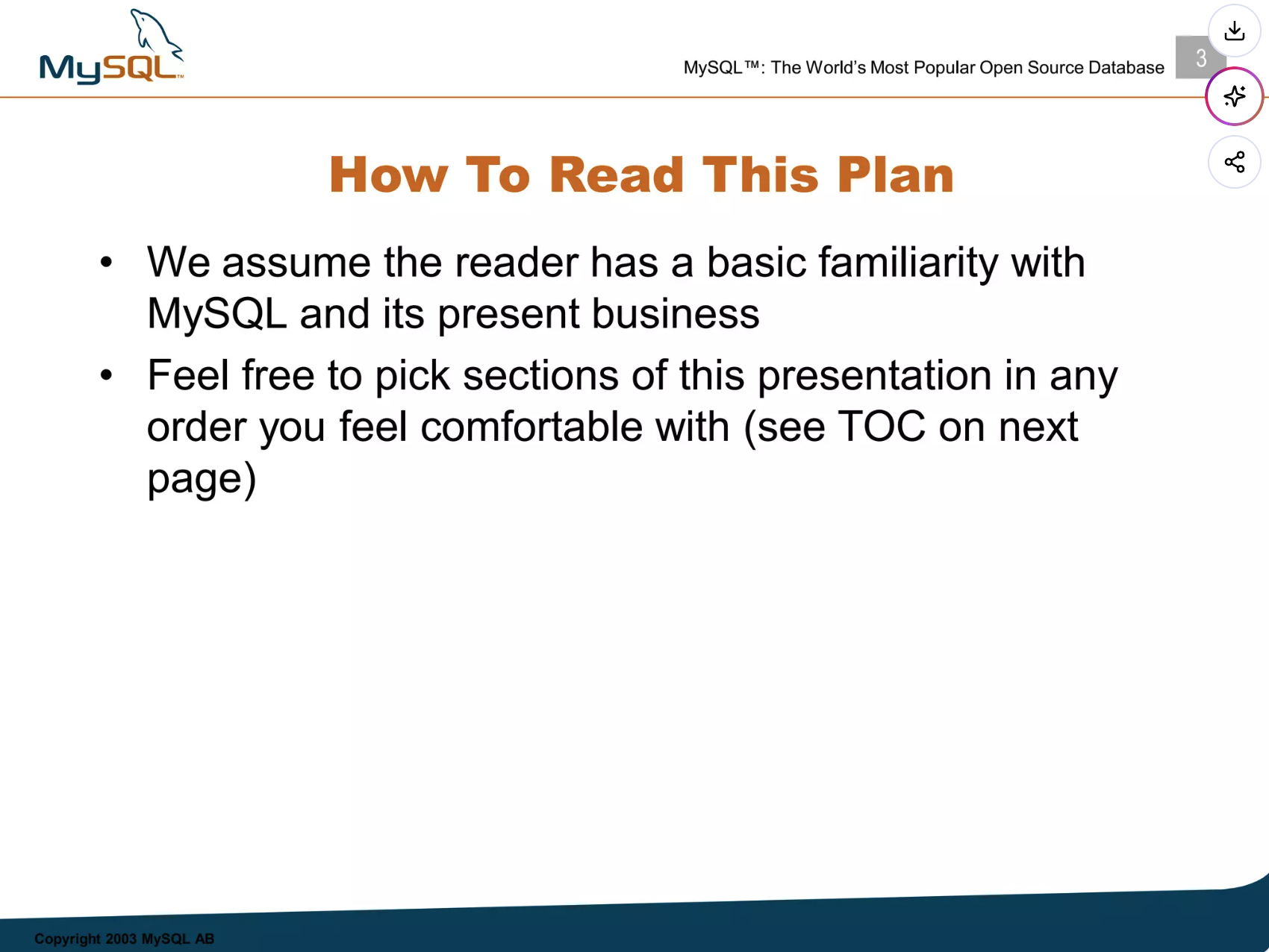
Years later, CEO Mårten Mickos posted about the deck on Facebook and advised young founders to keep their pitch decks much shorter (thank the Lord).
By then, investors were ready to set some rules.
Then came the template era (2000s)
Decks got shorter in the 2000s (phew!), but it was a slooow process. LinkedIn’s Series B deck—which helped the company raise $10M—from 2004 had 38 slides, plus five more in an appendix.
Co-founder Reid Hoffman published the deck in 2013, with notes on every slide. And in those notes, he reveals his little secret: the team left its closing slide on screen during questions to hide the fact that there was an appendix. That way, investors wouldn’t expect a walk through every extra slide, and the team could pull one up only when a question called for it. Sneaky guy, Hoffman.
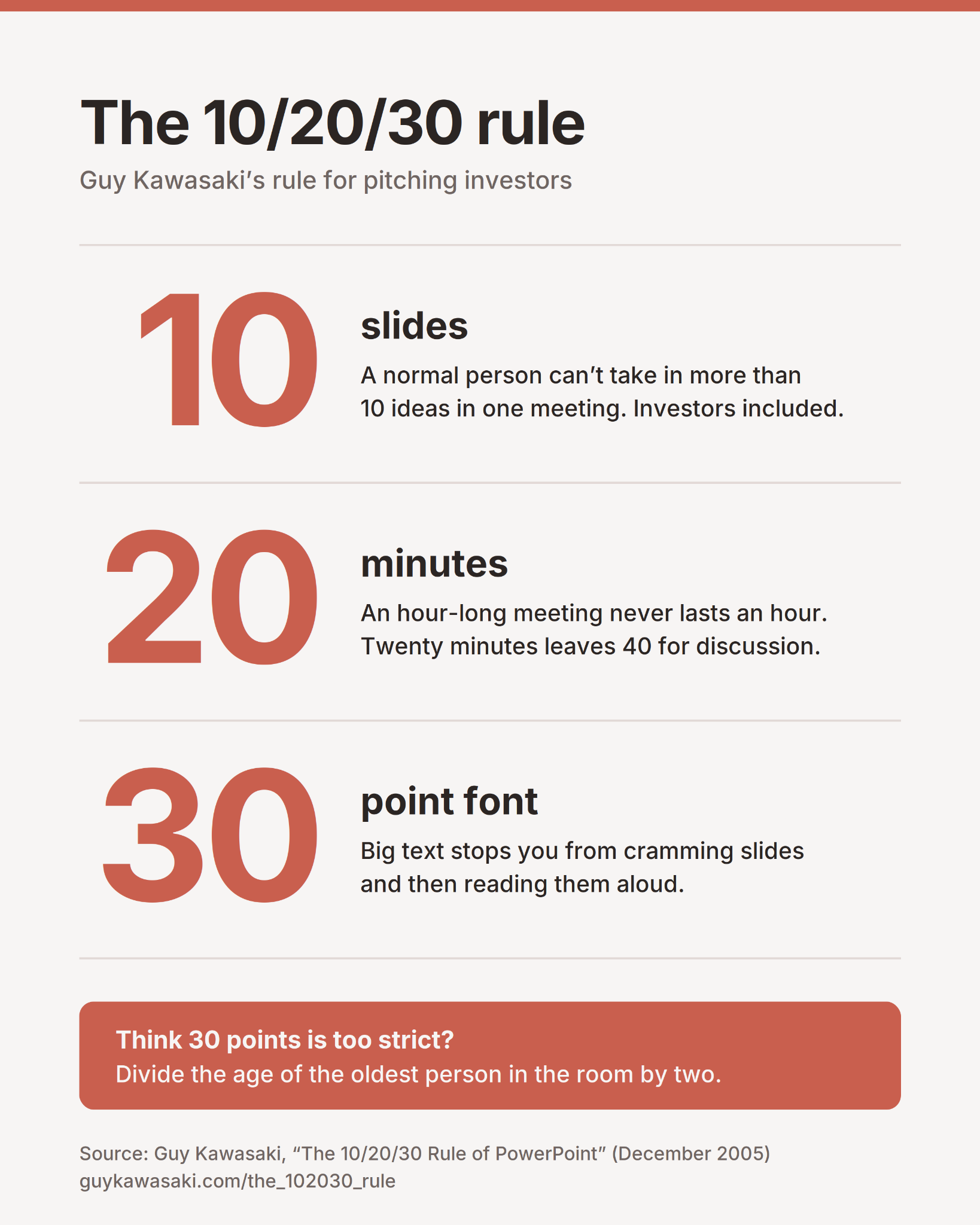
Later that year, investor Guy Kawasaki went further. He wrote his 10/20/30 rule after sitting through hundreds of pitches, many of them 60 slides long. He even said that they were ruining his hearing—don’t worry, it was a joke. The rule is simple: 10 slides, 20 minutes, and no font smaller than 30 points. Each number has a reason behind it.
-
Ten slides, because nobody takes in more than 10 ideas in one meeting, and Kawasaki said “venture capitalists are very normal.” If you need more, he suggested, you may not have a business.
-
Twenty minutes, because if you’ve ever sat in an hour-long meeting, you know it never really lasts an hour. Setup eats time, people arrive late, and someone leaves early. Twenty minutes leaves 40 for discussion.
-
Thirty-point font, because small text tempts founders to cram slides and read them aloud while the audience reads ahead.
Kawasaki wasn’t the only investor tired of decoding founders’ slides. Sequoia published its own checklist in a guide to writing a business plan, and it reads like the questions a partner would ask across the table.
-
What does your company do, in one sentence? Sequoia warns that this is harder than it looks, because founders tend to list features instead of explaining why the company exists.
-
What hurts for your customer today?
-
Who else is trying to fix it?
-
Why hasn’t someone built this already?
-
And the question to rule them all: why now?
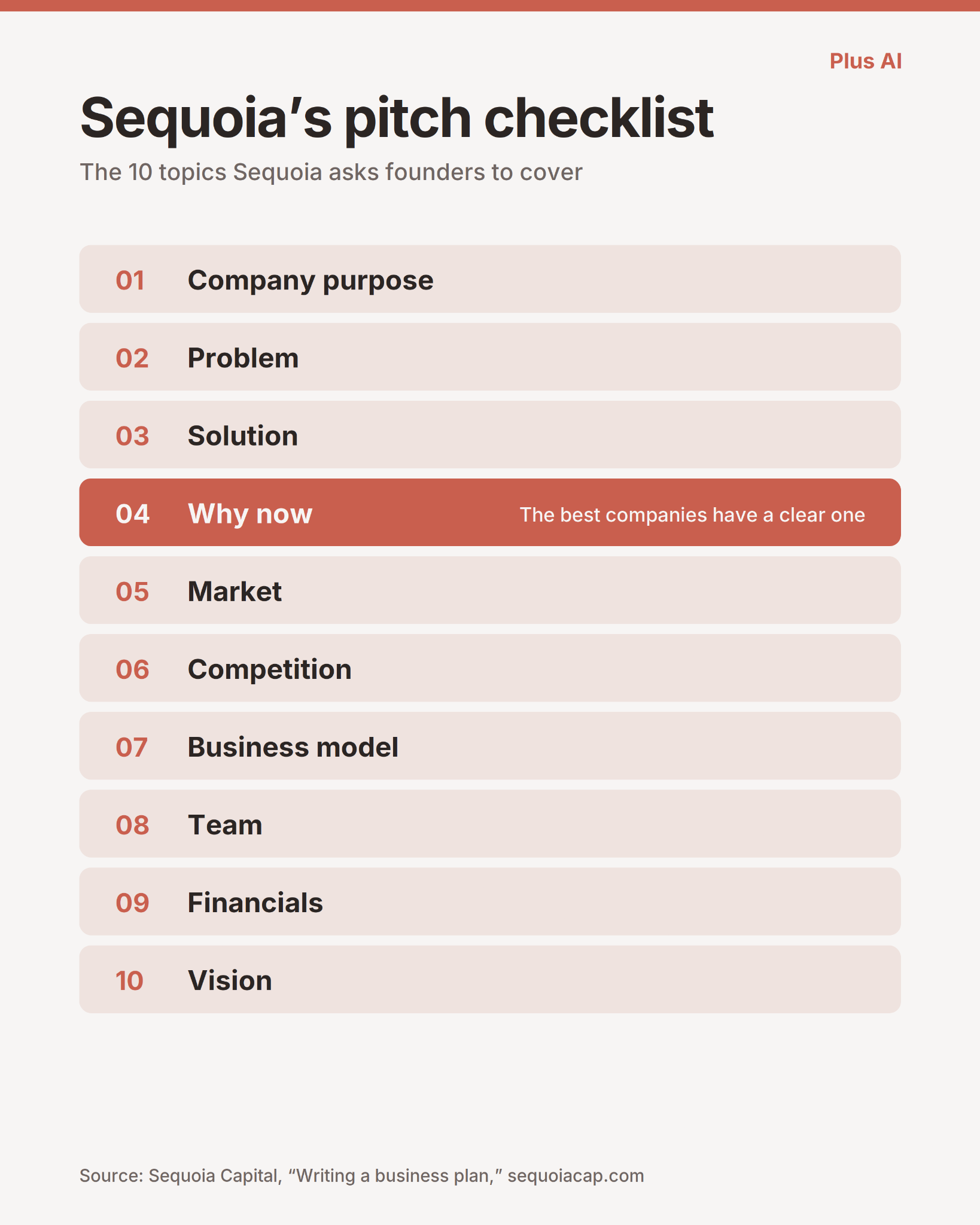
Sequoia’s guide argues that the best companies almost always have a clear answer. And the blueprint found at least one famous set of readers. Sequoia says Airbnb’s founders came to it with an air mattress, a lot of ambition, and no idea how to pitch a VC. They used the guide to build their first deck. Sequoia liked the deck, but says what won it over was the founders’ thinking, not the slides.
That Airbnb deck marks the start of the next era.
We arrive at the lean seed deck (2008–2012)
Airbnb’s early fundraising is the favorite underdog story of this era. In June 2008, a friend introduced the founders to seven well-known investors. They were trying to raise $150,000 at a $1.5 million valuation.
In a 2015 post, Brian Chesky shared how that went: five investors said no, and the other two never wrote back. He added (rather generously) that he was sure the team didn’t look very impressive at the time.
Less than a year later, things looked different. Sequoia invested $585,000 in April 2009. At that point, Airbnb had a basic website, 2,500 listings, and 10,000 registered users. This was the round the founders pitched with the deck they built from Sequoia’s guide, as we discussed earlier.
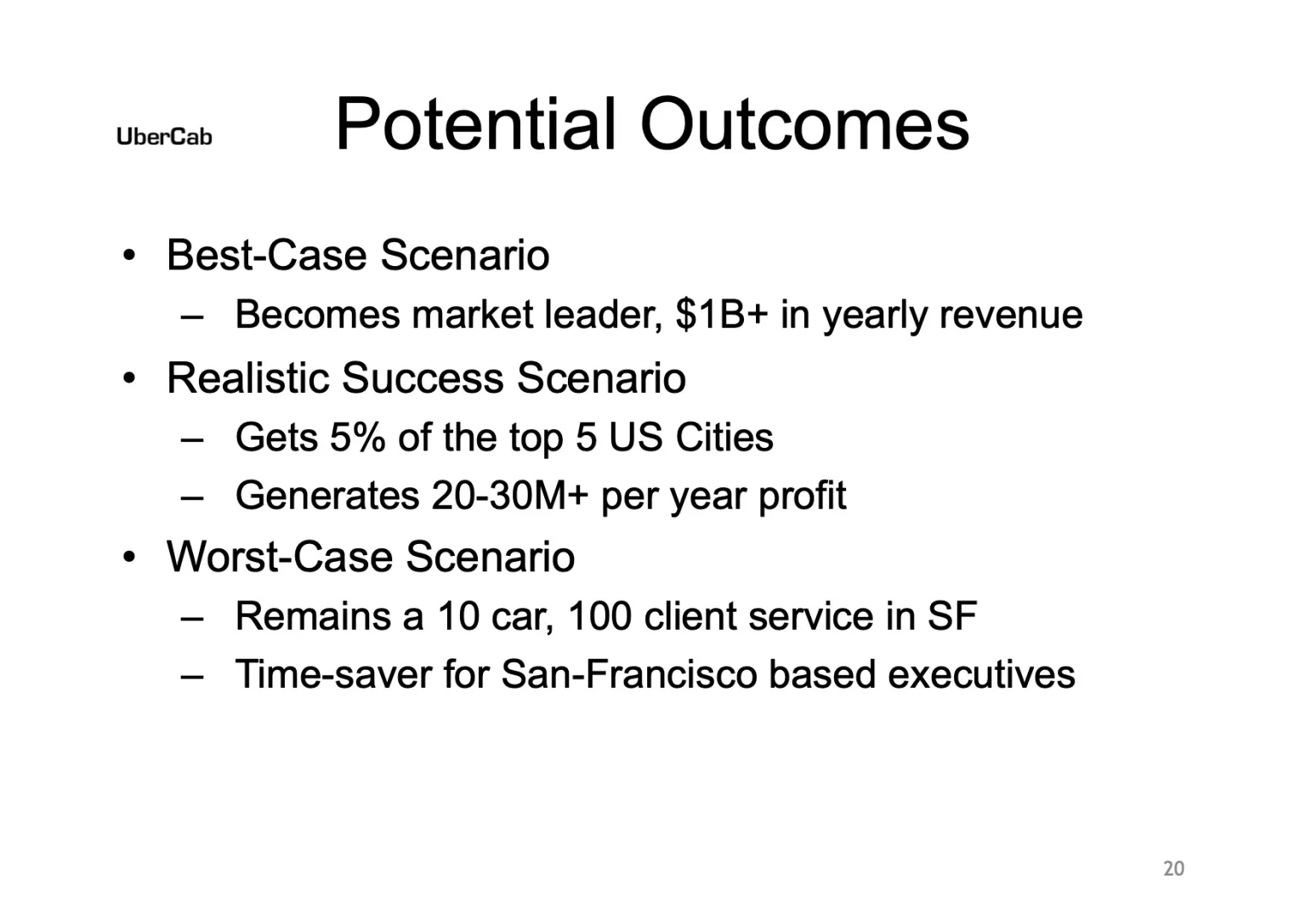
UberCab’s first deck came together around the same time. Co-founder Garrett Camp shared it on Medium in 2017. He called it the very first pitch deck the team made, in late 2008, just a few months after the idea came up.
Buffer’s founders went a step further and published their seed deck along with the story of how the round came together. Co-founder Leo Widrich wrote that the team contacted about 200 investors, met with about 50, and closed $450,000 from 18 of them.
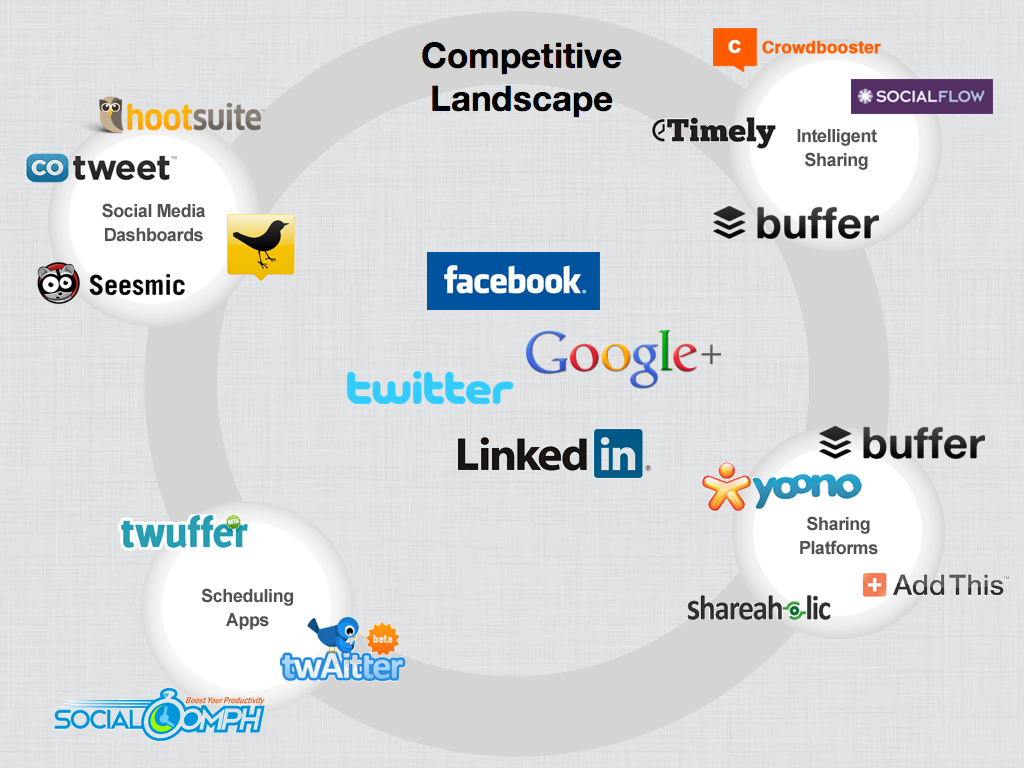
That’s a lot of emails for 18 yeses. He also named the slide that gave them the most trouble: competition. Investors kept getting confused by it, so the team rebuilt it until Buffer’s position was easy to follow.
The next shift changed how investors read decks in the first place.
Then pitches moved to the inbox (2010s–2020s)
By the 2010s, a lot of pitches started with an email, not a meeting. Founders sent a link to their deck, and investors read it on their own, often before deciding whether to meet at all.
Tools like DocSend grew up around that habit. A founder shares a deck as a link, and the tool tracks how investors view it (a little…creepy? But necessary, I suppose): how many decks they open and how long they spend on each. A deck that had to work without its founder in the room needed to explain itself.
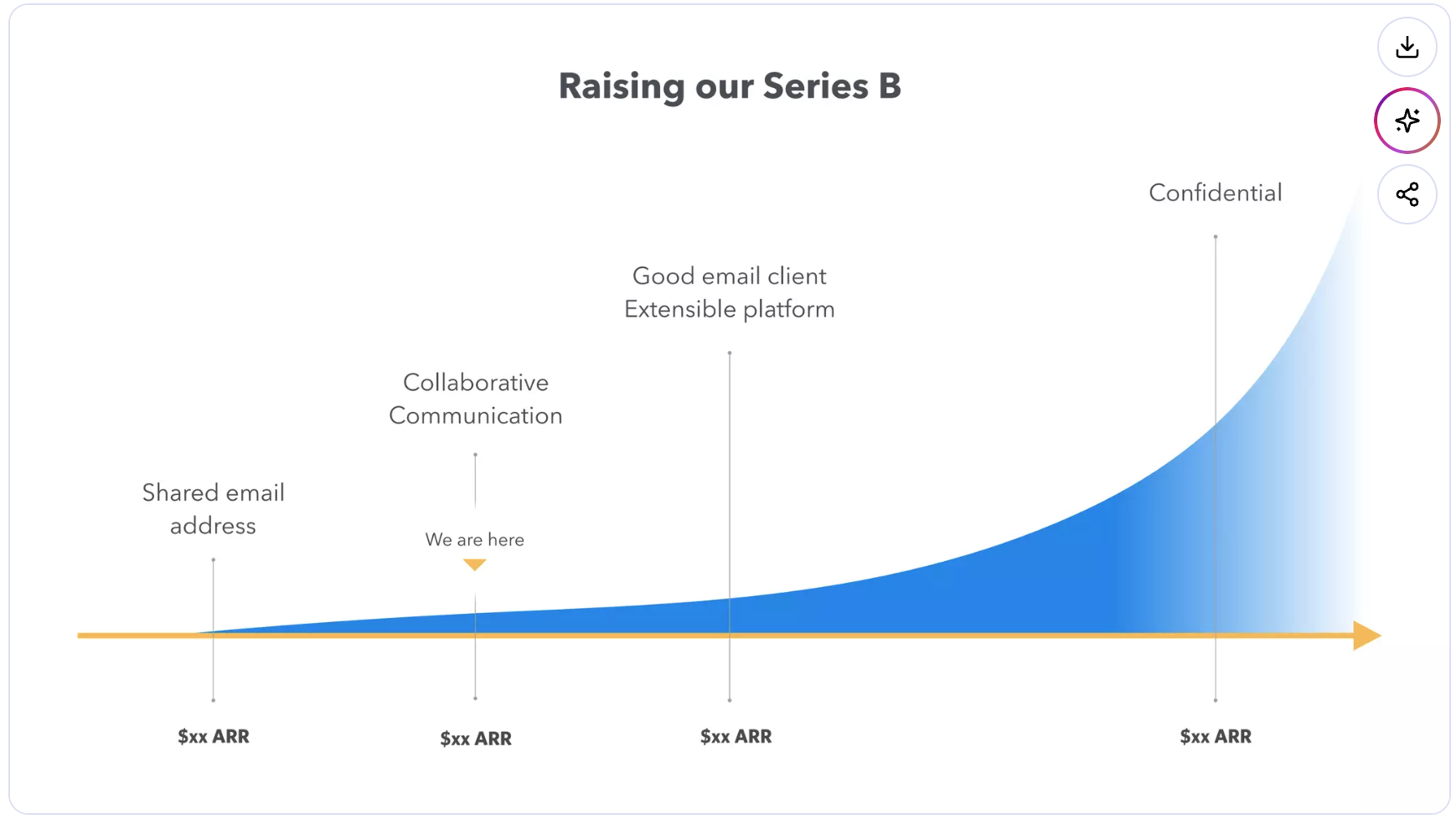
Front’s co-founder Mathilde Collin felt the pressure of that firsthand. When she raised Front’s $10 million Series A in 2016, she had never built a deck before. She hadn’t needed one for the seed round, after all. So she went looking for examples and found very few, especially from SaaS companies.
For a while, she spent most of her working days on that one file, gathering data and reworking slides after each round of investor feedback. Once the round closed, she published the deck so the next founder wouldn’t come up as empty-handed.
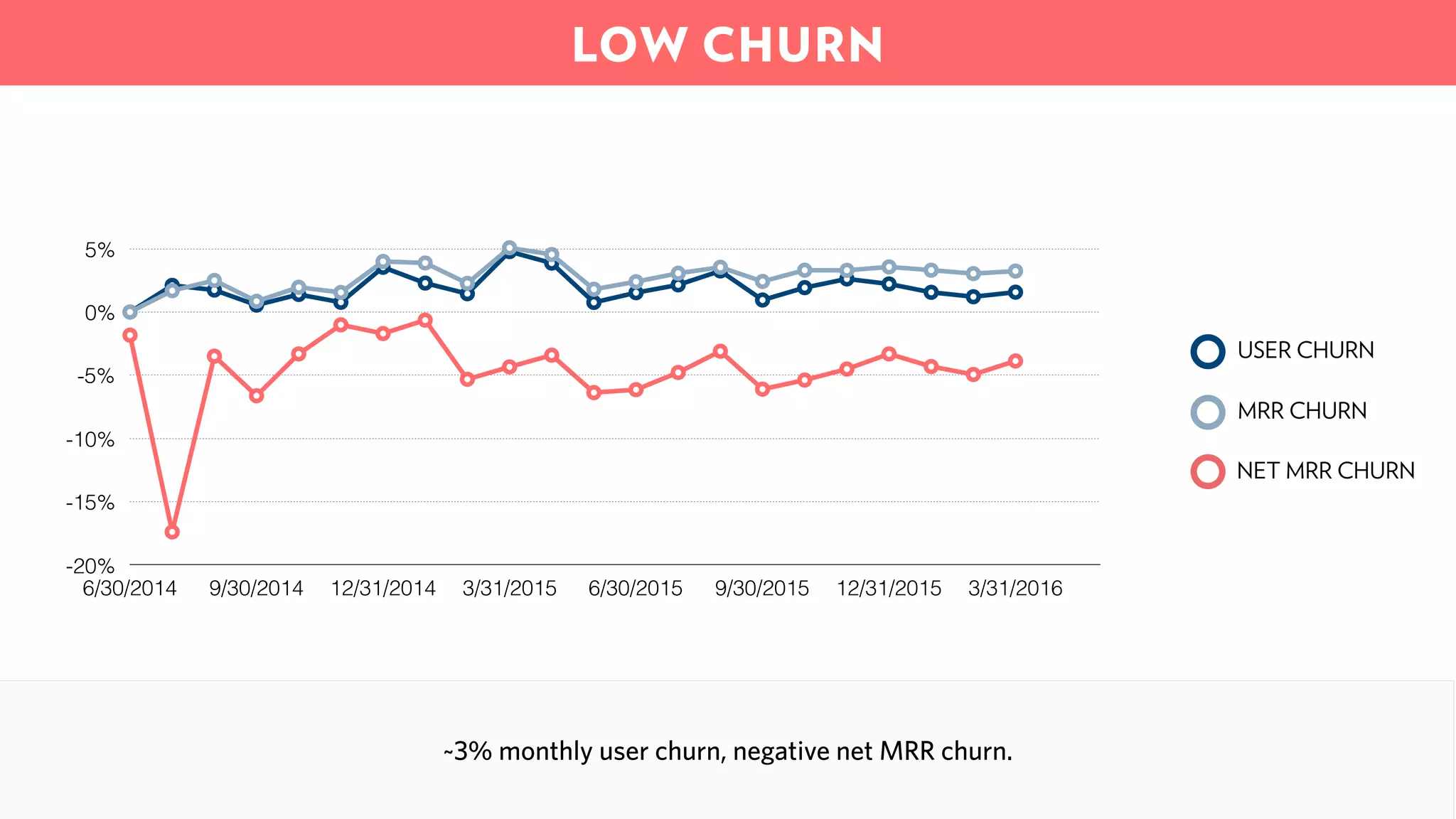
She also shared what investors liked most, and it wasn’t anything flashy. They liked that Front spent less than it earned in annual recurring revenue, and that customers spent 50% more after a year. She later shared the Series B deck too.
And in the pandemic, remote work pushed things further. DocSend’s owner, Dropbox, notes that virtual investor meetings are now the norm and in-person networking matters less than it used to. That puts even more weight on the deck itself.
With remote viewing, a deck also has less time to make its case. In one week of June 2024, DocSend’s data showed investors spent an average of 2 minutes and 18 seconds on each deck. For a 15-slide deck, if my math is correct, that’s about nine seconds a slide. So about the same time you spend on a TikTok video before scrolling away. Cool cool cool cool.
Through all these changes, investors kept asking the same few questions.
And finally…came AI 🎉
For most of this history, the slow part of a pitch was making the deck itself. Founders typed, formatted, aligned boxes, and fixed fonts at 2 a.m. AI took over a lot of that work.
Now, tools like Plus AI build a draft deck from a prompt or an existing document, right inside PowerPoint or Google Slides. They can also apply a company’s own branding, so a founder starts with a full, on-brand draft instead of a blank slide.
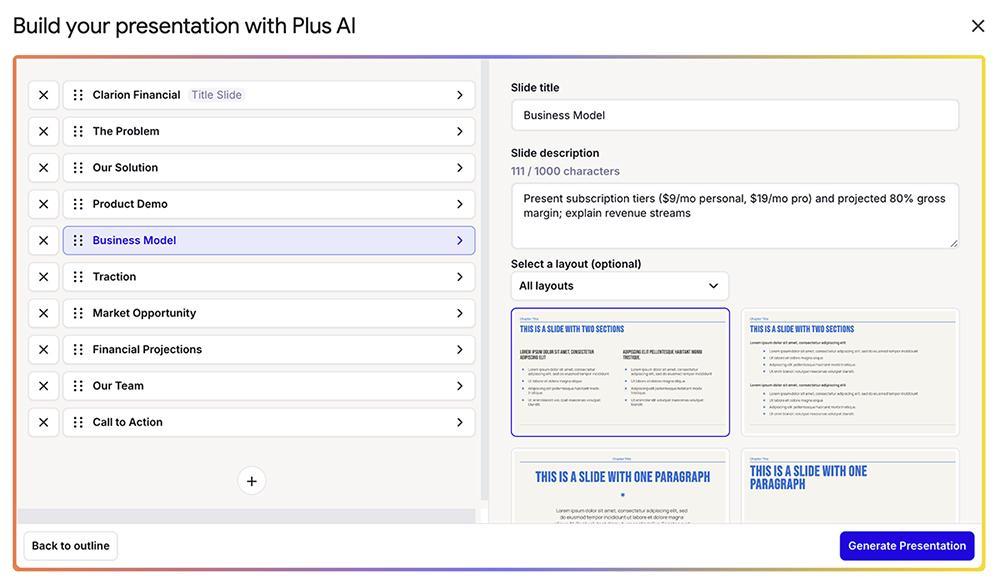
Remember Mathilde Collin, who spent most of her working days on Front’s Series A deck, gathering data, making projections, and reworking slides after every round of feedback? That’s exactly the kind of work AI now speeds up. A founder can go from a pile of notes to a full draft, then use the saved hours on the parts only they can do.
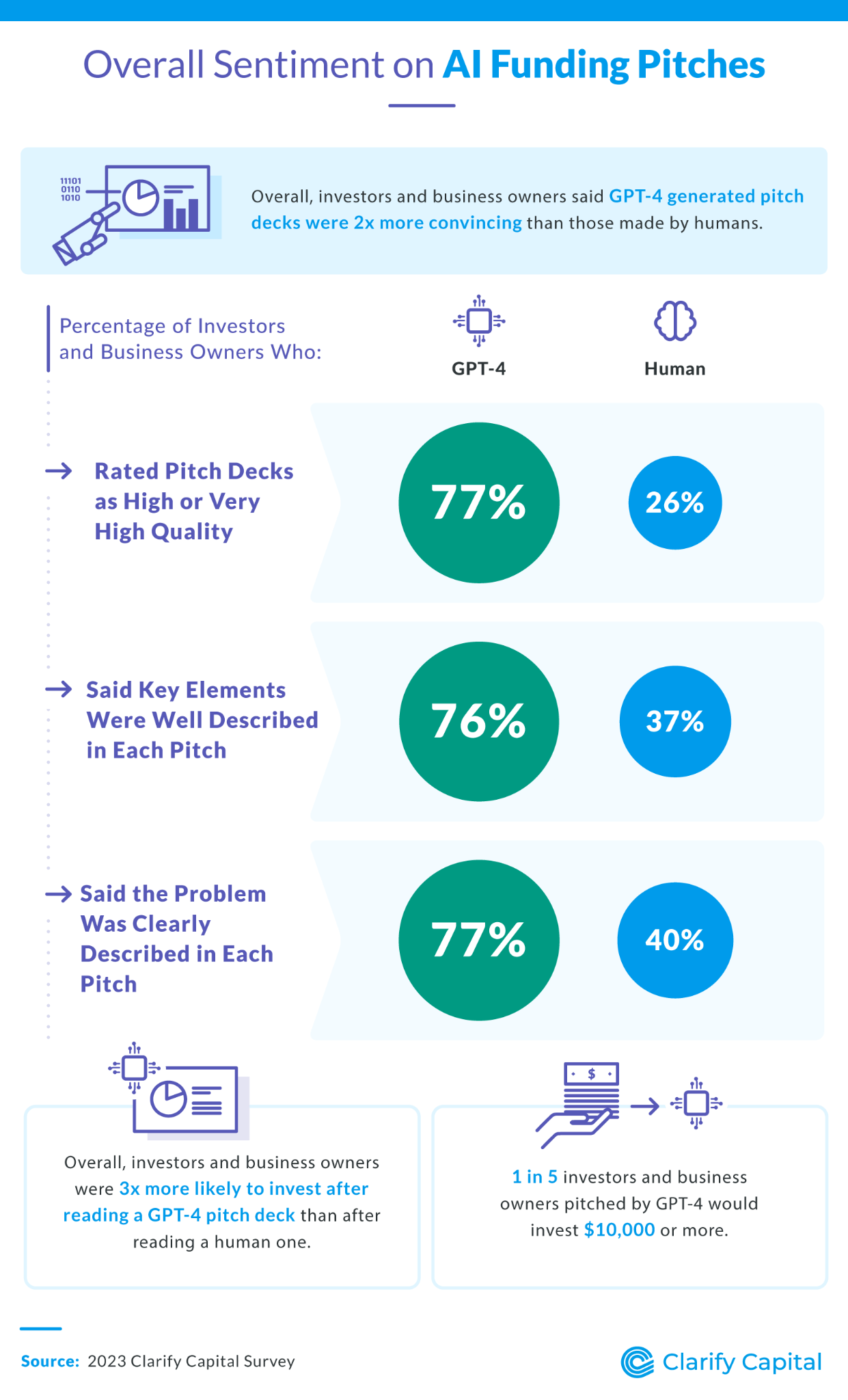
In a 2023 experiment by Clarify Capital, 250 investors and 250 business owners rated a mix of pitch decks without knowing some were written by GPT-4.
The human-made decks weren’t weak ones either: they had already helped their companies raise money. Even so, 80% of respondents found the AI-generated decks convincing, compared with 39% for the human ones.
The best way to use that head start is to spend it where investors have always looked. When Sequoia described Airbnb’s first deck, it said it wasn’t the slides it liked so much as the founders’ ideas and the clarity of their thinking. AI can take care of the slides. With AI handling the slides, founders get more time for exactly that.
One pro tip: In his notes on LinkedIn’s deck, Reid Hoffman suggested writing each slide title as a sentence that makes your point, so an investor can follow the whole argument from the titles alone. It’s a quick way to put your own thinking on top of an AI draft.
From typed plans to AI-assisted slides, here’s what’s always worked
Sixty years of pitch decks have produced a lot of rules. These five are the ones that have held up the whole way.
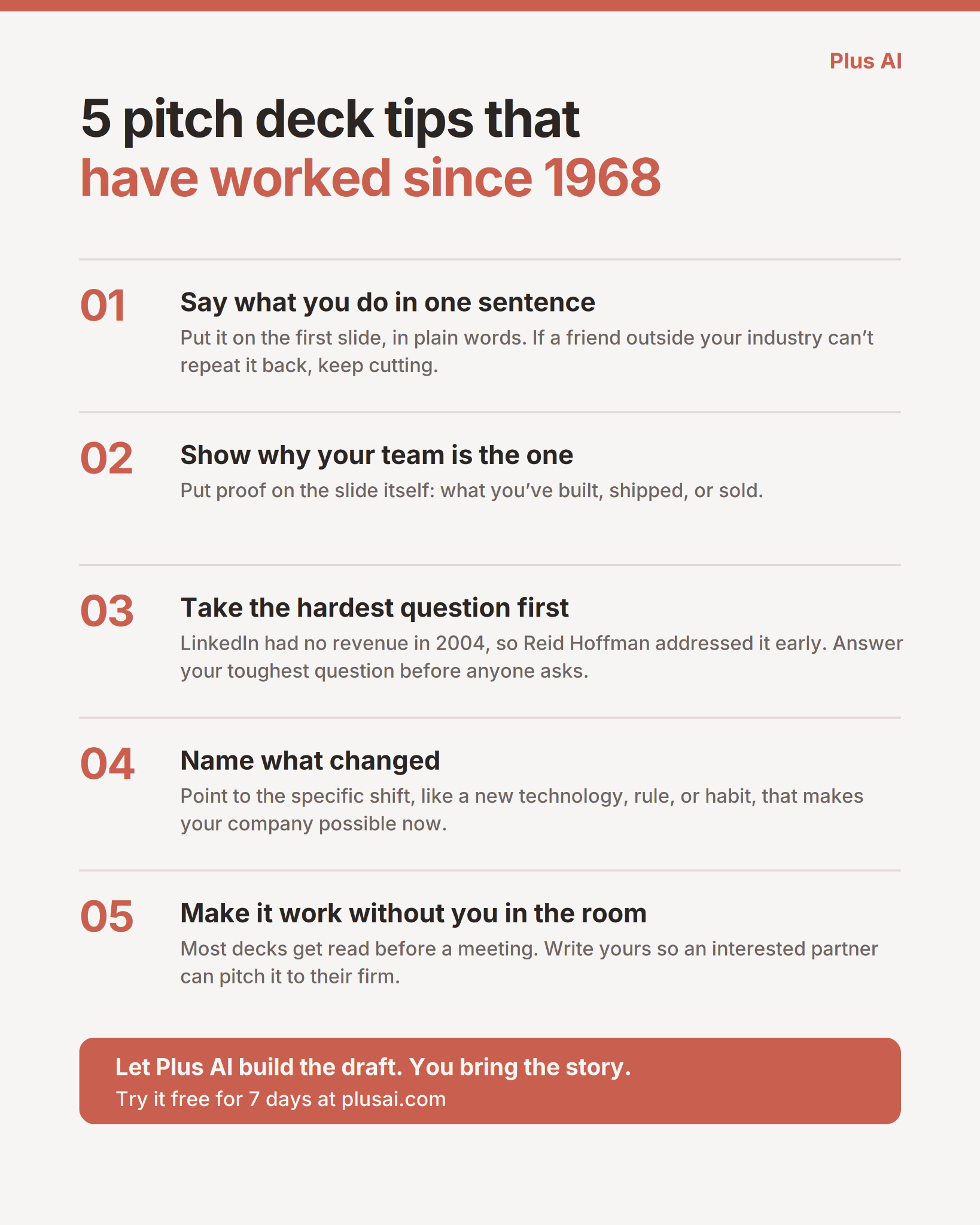
1. Say what you do in one sentence. Put it on the first slide, in plain words a friend outside your industry would understand. If they can’t repeat it back to you, keep cutting. Every slide after it should support that sentence.
2. Show why your team is the one. Nearly every investor memo in this story has something to say about the founders. Don Valentine’s 1977 memo on Apple questioned the management, and Sequoia invested anyway. Give investors proof on the slide itself: what you’ve built, shipped, or sold.
3. Take the hardest question first. LinkedIn had no revenue in 2004, so Reid Hoffman opened the pitch with it. It was investors’ biggest worry, and he wanted it out of the way early. Find your hardest question and answer it before anyone has to ask.
4. Name what changed. Investors want to know why your company works now when it wouldn’t have five years ago. Point to the specific shift, like a new technology, a new rule, or a change in how people behave, and say when it happened.
5. Make it work without you in the room. Most decks get read before any meeting, and often get passed to partners the founder never meets. Hoffman advises writing the deck so the partner who likes it can make the case to the rest of the firm. The same goes for length: if your deck needs a “how to read this plan” slide, like MySQL’s did, it’s probably too long.
Spend your time on the story
Every deck in this article had the same job: get an investor interested enough to want the next conversation. The format kept changing around that job, and it will keep changing.
Plus AI takes care of the building. It turns your notes, documents, or a simple prompt into a draft deck, right inside PowerPoint or Google Slides, in your company’s branding. You get back the hours Collin spent on slides, and you can put them into your argument instead.